
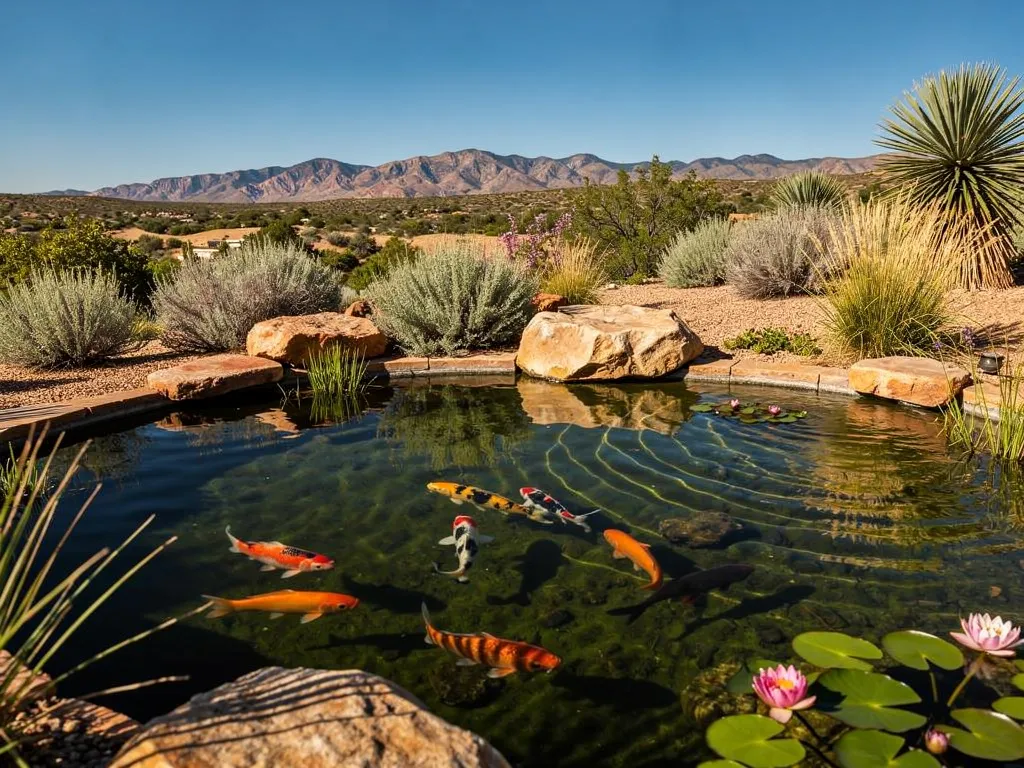
Best Water Plants for Ponds in New Mexico: What Should You Plant?
The best water plants for ponds in New Mexico are plants that can handle strong sunlight, dry air, seasonal temperature swings, and the specific conditions within your pond. Hardy water lilies, broadleaf arrowhead, coontail, American eelgrass, water sedges, and selected rushes are all worth considering, depending on the size and style of the pond.
The best pond planting plan usually includes more than one type of plant. Floating-leaved plants provide shade, submerged plants grow below the surface, and marginal plants soften the shoreline and create habitat. Used together, they can make a backyard pond look more natural while supporting a healthier aquatic environment.
Choosing plants in New Mexico requires a little more planning than simply picking whatever looks good at the nursery. Elevation and winter temperatures can vary considerably across the state. The USDA recommends using its Plant Hardiness Zone Map to determine which perennial plants are likely to survive at a specific location.
That means a pond plant that overwinters easily in Albuquerque may need more protection at a higher-elevation property near Santa Fe.
Quick Guide: Best Pond Plants for New Mexico
| Pond Plant | Type | Best Use | New Mexico Considerations |
|---|---|---|---|
| Hardy water lily | Floating-leaved | Shade, flowers, fish cover | Choose hardy varieties for easier overwintering |
| Broadleaf arrowhead | Marginal | Pond edges and shallow shelves | Native to New Mexico |
| Coontail / hornwort | Submerged | Underwater habitat and nutrient uptake | Native to New Mexico and easy to establish |
| American eelgrass | Submerged | Natural and ecosystem ponds | Native aquatic species used in NM restoration |
| Canada waterweed | Submerged | Fish habitat and underwater planting | Native to New Mexico |
| Water sedge | Marginal / shoreline | Natural pond edges | Native and useful in naturalistic plantings |
| Hardstem bulrush | Emergent | Larger ponds and shoreline areas | Better for larger spaces because it spreads |
| Yellow pond-lily | Floating-leaved | Natural ponds and larger water gardens | Best used where conditions are appropriate |
| New Mexico checkermallow | Pond-edge | Color and pollinator habitat | Excellent around moist pond margins |
The ideal combination depends on whether you have an ecosystem pond, koi pond, natural pond, or decorative backyard water garden.
Why Are Aquatic Plants Important in a Backyard Pond?
Aquatic plants are not just decoration. They are part of the pond environment.
Plants can absorb nutrients from the water, create shelter for aquatic life, shade portions of the pond, stabilize shallow edges, and make the transition between water and surrounding landscaping feel more natural. The original pond-plant article correctly emphasized nutrient absorption, shoreline stability, and wildlife habitat as important functions of aquatic vegetation.
Aquatic plants generally fall into three major groups: submerged, emergent or marginal, and floating or floating-leaved plants. Each occupies a different part of the pond and performs a different role.
A healthy pond does not necessarily need to be packed with vegetation. Too much plant growth can actually become a problem by covering the surface, reducing light penetration, and contributing to low oxygen conditions.
The goal is balance.

1. Hardy Water Lilies
For most ornamental ponds, hardy water lilies are one of the best pond plants for New Mexico.
Their floating leaves bring immediate visual interest to the surface, while their flowers create the classic water-garden appearance many homeowners want. The leaves also provide shade and shelter around fish.
Unlike tropical lilies, hardy varieties are better suited to surviving cold winters when properly positioned in the pond. Water lilies generally perform best with plenty of sunlight, although exact requirements vary by cultivar. Missouri Botanical Garden notes that water gardens intended for flowering lilies generally benefit from at least five hours of direct sunlight.
Why water lilies work well
- Provide attractive floating foliage
- Produce colorful seasonal flowers
- Create shade across part of the pond
- Offer cover for koi and other fish
- Provide a natural transition between open water and planted areas
- Hardy varieties can return year after year
What should New Mexico homeowners know?
Avoid choosing a lily based on flower color alone.
Consider its mature spread, recommended planting depth, sunlight requirements, and winter hardiness. A vigorous lily that is perfect for a large ecosystem pond can quickly overwhelm a small courtyard pond.
Hardy water lilies can generally remain outdoors during winter if their growing point remains below the portion of the pond that freezes.
2. Broadleaf Arrowhead
Broadleaf arrowhead (Sagittaria latifolia), sometimes called duck potato, is an excellent choice for natural-looking pond margins.
Unlike a water lily, arrowhead grows upright from shallow water. Its distinctive arrow-shaped leaves add vertical form around the edge of a pond and work especially well among rocks, gravel, and other marginal plantings.
It is also genuinely relevant to a New Mexico plant guide. Broadleaf arrowhead occurs naturally in New Mexico.
Best uses
- Shallow pond shelves
- Ecosystem pond edges
- Wildlife ponds
- Naturalistic water gardens
- Transitional areas between water and landscaping
It can spread once established, so smaller ornamental ponds may benefit from growing it in planting pockets or containers where its expansion can be controlled.
3. Coontail or Hornwort
Coontail (Ceratophyllum demersum), commonly called hornwort, grows primarily below the surface.
Submerged plants are useful because they occupy an entirely different part of the pond than lilies and marginal plants. They take nutrients directly from the water column and provide underwater structure where small aquatic organisms and fish can find cover.
Coontail has a broad natural distribution that includes New Mexico.
Why consider coontail?
- Grows below the surface
- Provides underwater cover
- Uses nutrients from the water
- Does not require a decorative shoreline planting area
- Works in naturalistic and ecosystem-style ponds
It can grow vigorously under favorable conditions, so it should still be monitored rather than simply added and forgotten.
4. American Eelgrass
American eelgrass or tape grass (Vallisneria americana) is another submerged plant worth considering for larger natural and ecosystem ponds.
Rather than floating on the surface, long ribbon-like leaves grow upward through the water.
American eelgrass has particular local relevance. It is among the native submerged aquatic species selected for vegetation restoration work at Cochiti Lake, along with Canada waterweed and coontail.
Best suited for:
- Larger ecosystem ponds
- Natural ponds
- Wildlife-oriented ponds
- Areas where underwater vegetation is desired
It may be more plant than a small decorative pond needs, but it can be valuable when the goal is to create a more complete aquatic ecosystem.
5. Canada Waterweed
Canada waterweed (Elodea canadensis) is another submerged aquatic plant that can work well in the right New Mexico pond.
Like coontail and eelgrass, it grows underwater and provides structure within the water column. It was also included among native aquatic plants selected for restoration at Cochiti Lake.
Submerged plants such as Elodea can absorb nutrients and create shelter for young fish and aquatic organisms.
However, submerged vegetation should be managed rather than allowed to fill every available area. The goal is a balanced pond, not an underwater jungle.
6. Water Sedge
For homeowners who want a pond to blend naturally into a New Mexico landscape, water sedge (Carex aquatilis) deserves consideration.
Water sedge grows around wet margins rather than floating across the pond. Its grass-like appearance creates a softer transition between water, stone, and surrounding landscaping.
It is native to New Mexico and occurs in montane wetlands and portions of the Upper and Middle Rio Grande Basin.
Water sedge works particularly well for:
- Natural pond edges
- Wildlife ponds
- Larger ecosystem ponds
- Moist shoreline areas
- Landscapes designed to feel less formal
It can also provide an attractive contrast to large boulders and broad-leaved aquatic plants.
7. Hardstem and Softstem Bulrush
Bulrushes are excellent examples of plants that can be extremely useful in one pond and completely inappropriate in another.
Species of hardstem and softstem bulrush occur in Southwestern wetland environments and have been used in New Mexico riparian restoration plantings. A restoration project at Ohkay Owingeh included several rush and bulrush species along with broadleaf arrowhead and New Mexico checkermallow.
Their tall vertical stems can create a beautiful natural shoreline and provide habitat.
However, they can become large.
Best for:
- Larger natural ponds
- Wildlife ponds
- Broad shallow planting shelves
- Properties where a natural wetland appearance is desirable
Less suitable for:
- Very small ponds
- Formal water gardens
- Areas where unrestricted spreading would be difficult to manage
For compact backyard ponds, use them selectively or keep them contained.
8. Yellow Pond-Lily
Yellow pond-lily (Nuphar species) can be an attractive alternative to the more familiar ornamental water lily in the right environment.
New Mexico flora records include yellow pond-lily, and Forest Service vegetation classifications document pond-lily communities in Southwestern aquatic habitats.
This is generally a better option for larger or more naturalistic ponds than a small formal water garden.
Because New Mexico varies so much in elevation and winter climate, species and cultivar selection should be matched to the individual site rather than assuming every aquatic plant will perform equally well statewide.
9. New Mexico Checkermallow for the Pond Edge
Not every plant around a pond needs to sit in standing water.
New Mexico checkermallow (Sidalcea neomexicana) is a useful example of a plant that can help connect an aquatic feature to the surrounding landscape.
It has been incorporated into New Mexico wetland restoration plantings alongside rushes, bulrushes, and arrowhead.
Its flowers can add color near the pond while the surrounding vegetation helps make the entire water feature feel more established.
This is particularly useful for high-end pond design because a beautiful pond should not end abruptly at the liner or rock edge. The planting around it is part of the composition.
What Are the Best Plants for a Koi Pond in New Mexico?
Koi ponds require a slightly different approach because the fish themselves affect the plants.
Koi may investigate, disturb, or uproot vegetation, especially newly planted material. Plants may need to be installed in sturdy aquatic baskets, protected planting pockets, or areas that the fish cannot easily access.
Good options to consider include:
Hardy water lilies
Their floating leaves create shade and cover while adding flowers and color to the pond.
Marginal arrowhead
Arrowhead works well on shallow shelves where roots can be protected from fish activity.
Rushes and sedges
Marginal plants can create attractive planted zones while keeping most of their foliage above the water.
Submerged vegetation
Plants such as coontail can add underwater habitat, although koi may interact with or consume some submerged vegetation.
Most importantly, plants should support a koi pond’s filtration and circulation system, not replace it.
The original article suggested that natural planting could eliminate pumps and filters. For a designed koi or ornamental pond, that is too broad. Plants can contribute to nutrient management and ecosystem health, but fish load, circulation, aeration, filtration, pond volume, and water quality still need to be considered together.
Which Pond Plants Help With Algae?
No single plant makes an algae problem disappear.
Aquatic plants can help because they use nutrients that algae also depend on, while floating leaves can shade portions of the water. Submerged plants also compete for nutrients within the water column.
But more plants are not always better.
A pond completely covered by lilies, duckweed, or other vegetation can reduce light and oxygen exchange enough to negatively affect aquatic life.
Algae control should therefore be approached as a whole-pond issue that considers:
- Plant balance
- Sun exposure
- Filtration
- Circulation
- Aeration
- Fish load
- Organic debris
- Nutrient levels
- Feeding practices
If a pond repeatedly develops excessive algae, simply buying more plants may treat the symptom without solving the underlying cause.
How Much of a Pond Should Be Covered With Plants?
A healthy pond should still have visible open water.
There is no universal percentage that works for every koi pond, wildlife pond, and ornamental water garden. The ideal amount depends on the pond’s depth, fish population, sunlight, circulation, and plant species.
As a general reference, avoid allowing floating and deep-water vegetation to dominate the entire surface. Maintaining a meaningful open-water area is important for light and gas exchange.
For a professionally designed pond, planting should be planned in zones rather than by randomly adding plants until the pond looks full.
A balanced design might include:
Surface interest from lilies
Shallow-water structure from arrowhead or rushes
Underwater vegetation from coontail or eelgrass
Shoreline transition from sedges and moisture-loving perennials
This approach generally looks much more intentional as well.
Which Pond Plants Work Best in Full New Mexico Sun?
New Mexico sunlight can be intense, particularly around exposed Albuquerque landscapes.
Many flowering aquatic plants appreciate substantial sunlight. Water lilies, for example, generally bloom best with good sun exposure.
The pond itself, however, may benefit from some shade during the hottest part of the year. Penn State notes that partial shade can help reduce overheating and excessive algae in smaller ponds.
This is another reason plant placement matters.
Instead of treating sunlight as simply “full sun” or “shade,” a pond designer can consider where afternoon shade falls, where lilies will spread, how nearby architecture affects temperature, and which parts of the pond need more protection.
What Pond Plants Survive Winter in New Mexico?
Winter survival depends heavily on where in New Mexico the pond is located.
Elevation creates significant differences in minimum temperature from one community to another, which is why the USDA recommends selecting perennial plants according to the site’s specific hardiness zone.
In general:
Hardy aquatic perennials
These can often remain in or around the pond through winter if planted at the correct depth and suited to the local hardiness zone.
Hardy water lilies
They can typically overwinter in the pond when their rhizomes remain below the frozen portion of the water.
Tropical aquatic plants
These may need to be treated as annuals, moved indoors, or stored differently during winter.
Higher-elevation properties
Ponds in colder areas around Santa Fe and northern New Mexico may require plant choices and winter procedures different from lower-elevation Albuquerque properties.
Buy based on your actual property, not simply a label that says “New Mexico.”
What Aquatic Plants Should You Avoid in New Mexico?
This is one of the most important parts of choosing pond plants.
An attractive plant sold for water gardens can become an ecological problem if it escapes into natural waterways.
New Mexico’s Aquatic Invasive Species Management Plan identifies several problematic aquatic plants, including:
- Hydrilla (Hydrilla verticillata)
- Brazilian waterweed (Egeria densa)
- Parrot-feather (Myriophyllum aquaticum)
- Eurasian watermilfoil (Myriophyllum spicatum)
- Purple loosestrife (Lythrum salicaria)
- Curly pondweed (Potamogeton crispus)
Eurasian watermilfoil is already present in New Mexico waterways including portions of the Rio Grande, Rio Chama, and Gila.
Water lettuce has also been reported in New Mexico.
Before buying an unfamiliar aquatic plant, verify its scientific name and current status. Common names can be confusing, and two plants sold under similar names may have very different ecological impacts.
Most importantly, never dump unwanted pond plants or pond water containing plant fragments into an arroyo, river, lake, irrigation ditch, or natural wetland.
Should You Choose Native or Ornamental Pond Plants?
You do not necessarily have to choose one or the other.
A beautiful New Mexico pond can combine appropriate native species with carefully selected non-invasive ornamental plants.
Native aquatic plants can provide:
- Regional character
- Wildlife value
- Proven adaptation to local environments
- A more naturalistic appearance
Ornamental pond plants can provide:
- Larger or longer-lasting flowers
- Specialized colors
- Compact growth habits
- More formal landscape character
For example, an ornamental hardy water lily may provide the dramatic flower display a homeowner wants, while native arrowhead and sedges around the edge make the pond feel connected to the New Mexico landscape.
The best design is often a thoughtful combination rather than an all-or-nothing approach.
How Should Pond Plants Be Arranged?
Plant placement can make the difference between a pond that looks intentionally designed and one that simply looks overgrown.
Think in layers.
Deep Water
Use floating-leaved plants such as water lilies to create focal areas on the surface.
Submerged Areas
Use appropriate underwater plants where additional aquatic habitat is desired.
Shallow Shelves
Plant marginal species such as arrowhead, rushes, and sedges.
Pond Edge
Transition into moisture-loving and then drought-tolerant landscape plants as you move away from the water.
That final transition is especially important in New Mexico.
A lush pond surrounded immediately by bare gravel can feel disconnected from the property. Gradually transitioning from aquatic vegetation into native stone, grasses, flowering plants, and xeric landscaping makes the pond feel more like a natural oasis within the high desert.
When Is the Best Time to Add Pond Plants in New Mexico?
Spring is generally the easiest time to establish hardy pond plants because they have an entire growing season ahead of them.
Exact timing depends on elevation, water temperature, plant type, and local frost conditions.
Hardy marginals can usually be introduced earlier than tropical aquatic plants. Tropical varieties should not be rushed outdoors simply because daytime temperatures feel warm. New Mexico’s large day-to-night temperature swings can still create problems early in the season.
If you are adding plants to an established koi pond, introduce them carefully and monitor both the plants and fish.
What Should You Ask Before Buying a Pond Plant?
Instead of buying an aquatic plant simply because it looks good at the nursery, ask:
- Is it hardy at my elevation and USDA zone?
- Is it native, non-native, or invasive in New Mexico?
- How large will it get?
- How quickly does it spread?
- How deep should it be planted?
- Does it need full sun?
- Can it overwinter outdoors?
- Is it appropriate for a koi pond?
- Does it need to be contained in a pot or planting pocket?
- Has it been treated with pesticides or chemicals that could affect fish?
That last question is particularly important when plants are going directly into a pond containing koi or other aquatic life.
Choosing the Best Water Plants for Your New Mexico Pond
There is no single plant list that works for every pond.
A small Albuquerque koi pond may benefit from a few hardy water lilies and carefully contained marginal plants. A larger ecosystem pond might incorporate arrowhead, sedges, submerged vegetation, rushes, and surrounding native plantings. A natural pond at higher elevation may require an entirely different mix.
The best planting plan considers:
- Pond size
- Water depth
- Sun exposure
- Elevation
- Winter temperatures
- Fish population
- Filtration
- Water movement
- Desired maintenance level
- Surrounding landscape
- Mature plant size
The goal should not be to fit as many species into the pond as possible. It should be to create a balanced composition where every plant has a purpose.
Frequently Asked Questions About Pond Plants in New Mexico
What are the best water plants for ponds in New Mexico?
Hardy water lilies, broadleaf arrowhead, coontail, American eelgrass, Canada waterweed, water sedges, and selected rushes are good options depending on the pond. The best combination depends on water depth, elevation, sunlight, fish, and the desired appearance.
What are the best plants for a koi pond in New Mexico?
Hardy water lilies are popular for koi ponds because they provide floating foliage and shade. Marginal plants such as arrowhead, rushes, and sedges can also work well when their roots are protected from the fish. Plant choice should be coordinated with the pond’s circulation and filtration system.
Do pond plants help keep the water clear?
Plants can help use nutrients, provide shade, and support the pond ecosystem, but they are only one part of water-quality management. Filtration, circulation, fish load, sunlight, feeding, and organic debris also influence water clarity.
Which pond plants are native to New Mexico?
Examples include broadleaf arrowhead, coontail, American eelgrass, Canada waterweed, and water sedge. Several native rushes and bulrushes also occur in New Mexico wetlands and riparian environments.
Can water lilies survive winter in New Mexico?
Hardy water lilies can survive winter in many New Mexico ponds when the cultivar is suited to the local hardiness zone and the rhizome remains below the portion of the pond that freezes. Higher elevations may require additional winter planning.
How many plants should I put in my pond?
There is no single number because plant quantity should be based on pond surface area, depth, species, sunlight, and fish load. Avoid covering the entire pond. Open water is important for light penetration, gas exchange, and the overall appearance of the feature.
Are pond plants good for wildlife?
Yes. Appropriate aquatic and shoreline plants can provide shelter, food, nesting material, and access to water for insects, birds, amphibians, and other wildlife. Native and regionally appropriate plantings can be especially useful when wildlife habitat is part of the design.
Can pond plants replace a filter?
Plants can contribute to nutrient uptake and ecosystem balance, but they should not be considered a replacement for properly designed circulation, aeration, and filtration, especially in a koi pond with a substantial fish load.
Create a Pond That Looks Natural in New Mexico
The best ponds are not simply holes filled with water and a few decorative plants. Stone, water, fish, aquatic plants, surrounding landscaping, circulation, and filtration should all work together.
The Art of Water designs custom koi ponds, ecosystem ponds, waterfalls, and water features throughout Albuquerque and New Mexico, with planting incorporated into the overall design rather than treated as an afterthought.
Whether you are planning a new backyard pond or looking to improve an existing water feature, thoughtful plant selection can make the pond more beautiful, more natural, and easier to enjoy.
Contact The Art of Water to discuss a custom pond design for your New Mexico property.