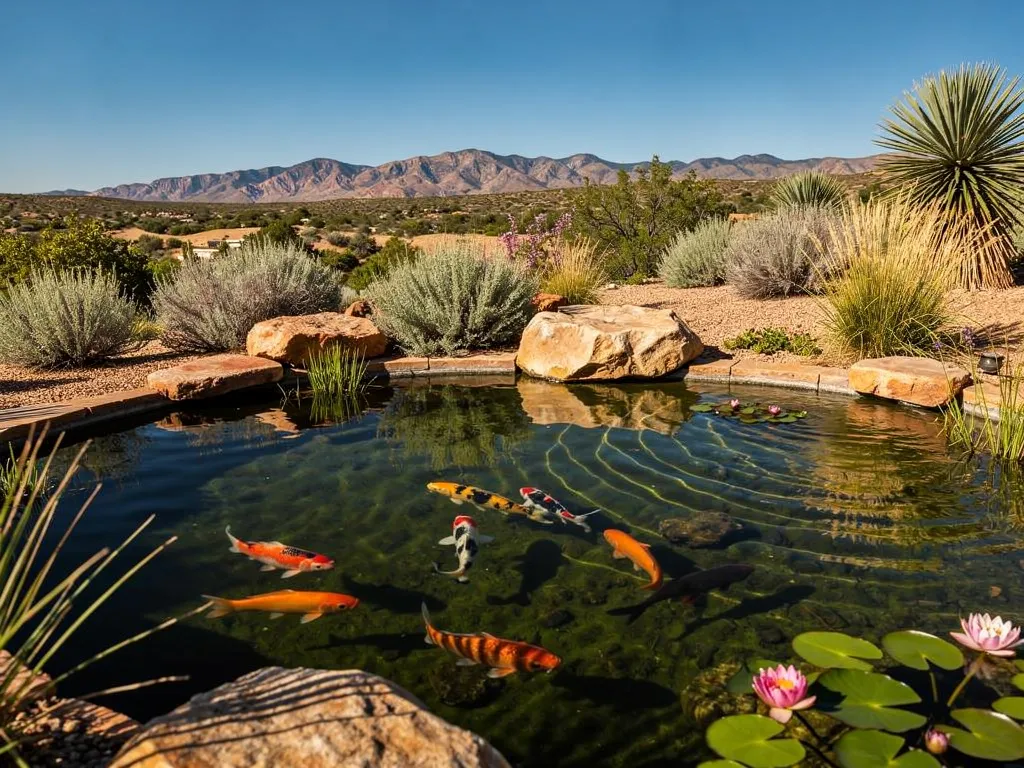
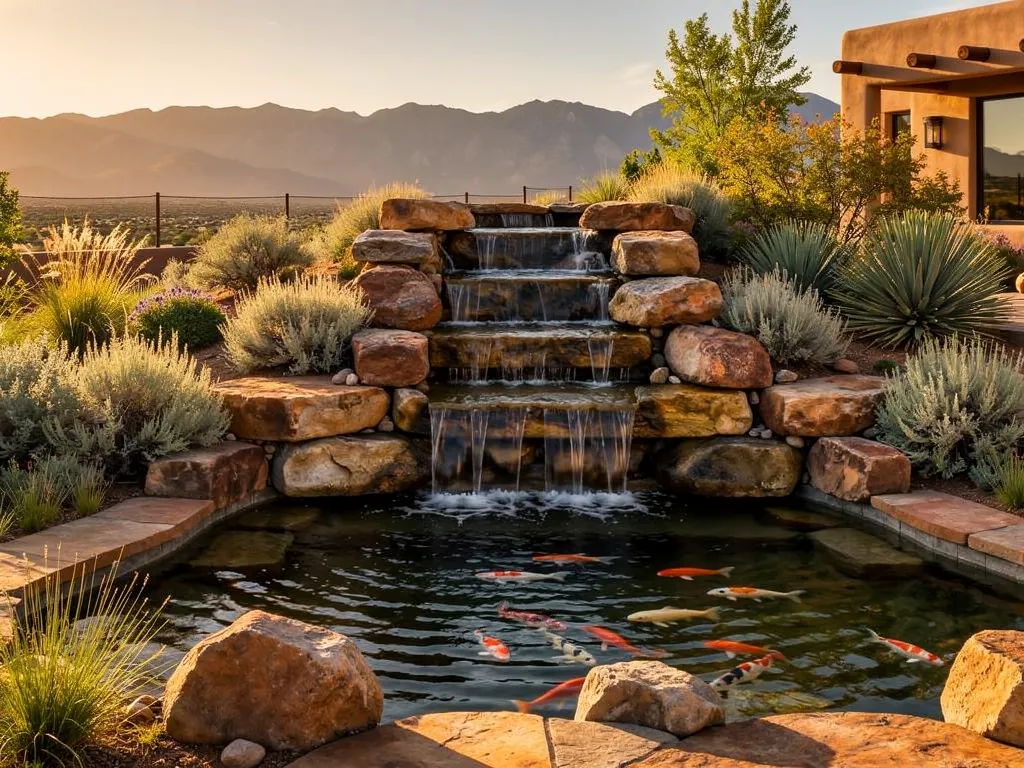
Custom water features in New Mexico can start around $4,500 for a professionally installed rock bubbler, $8,500 for a pondless waterfall, $15,000 for an ecosystem pond, and $20,000 or more for a professionally engineered koi pond. Larger ponds, streams, waterfalls, and estate-scale water features can exceed $40,000 depending on the design, stonework, equipment, and site conditions.
The actual cost of a custom water feature in New Mexico depends on much more than its overall size. A small bubbling fountain, pondless waterfall, ecosystem pond, and professionally designed koi pond all require different amounts of excavation, stone, plumbing, pumping equipment, filtration, and labor.
Property conditions also matter. Access to the installation area, existing slopes, soil conditions, electrical availability, and the amount of custom stonework can significantly affect the final investment.
For that reason, professionally designed water features are typically priced after the property and project have been evaluated rather than from a simple price-per-square-foot formula.
The Art of Water designs custom ponds, koi ponds, waterfalls, fountains, and other water features throughout New Mexico. Each project is designed around the property rather than selected from a standardized package.
Quick Answer: What Determines the Cost of a Water Feature?
The largest factors typically include:
- Type of water feature
- Overall size and depth
- Amount of excavation required
- Natural stone and boulder requirements
- Site accessibility
- Existing slope and grading
- Pump size and water-flow requirements
- Plumbing
- Filtration
- Electrical work
- Aquatic plants
- Landscape lighting
- Fish habitat requirements
- Streams and waterfalls
- Surrounding landscaping
- Complexity of the design
A simple fountain may require only a basin, pump, plumbing, and decorative materials. A large koi pond with waterfalls may require significant excavation, biological filtration, aeration, substantial stonework, aquatic planting areas, and much more powerful circulation equipment.
That difference is why two projects that both fall under the category of “water feature” can have very different costs.
Which Types of Water Features Cost the Most?
Different types of water features require different levels of construction and engineering.
The following chart is best viewed as a relative comparison, not a price sheet.
The actual price within each category depends on the property and design.
| Water Feature | Typical Starting Investment* | Best For |
|---|---|---|
| Rock Bubbler | $4,500+ | Entryways, patios, compact landscapes |
| Custom Fountainscape | $5,500+ | Courtyards, front yards, modern landscapes |
| Pondless Waterfall | $8,500+ | Moving water without an open pond |
| Natural Rock Waterfall | $10,000+ | Dramatic landscape focal points |
| Ecosystem Pond | $15,000+ | Natural ponds with plants and wildlife |
| Koi Pond | $20,000+ | Dedicated fish ponds and aquatic environments |
| Pond + Stream + Waterfall | $25,000+ | Complete backyard water environments |
| Estate Water Feature | $40,000+ | Large luxury landscapes and custom installations |
These figures are general starting points for professionally designed and installed water features. Every property and project is different. Final pricing depends on size, access, excavation, stone selection, equipment, filtration, electrical requirements, landscaping, and design complexity. An on-site consultation is required to provide an accurate project estimate.
How Much Does a Fountainscape Cost?
Fountains and rock bubblers are often among the more straightforward custom water features because they can be built without a large open pond.
A typical fountainscape may include:
- Decorative fountain or stone feature
- Underground reservoir
- Recirculating pump
- Plumbing
- Gravel or decorative stone
- Electrical connection
- Optional landscape lighting
- Surrounding planting or hardscape
A simple bubbling stone installed near an existing patio will generally require less construction than a group of large stone columns with multiple pumps, extensive lighting, and custom landscaping.
Typical starting investment: Professionally designed rock bubbler installations typically start around $4,500+, with pricing increasing for multiple stones, larger underground reservoirs, lighting, and additional landscape integration.
What can make a fountain more expensive?
The investment can increase with:
- Multiple fountain elements
- Large stone or ceramic pieces
- Fire elements
- Difficult access
- Custom reservoirs
- Higher water-flow requirements
- Lighting
- Significant electrical work
- Surrounding landscaping
Fountainscapes can be a good choice for homeowners who want the sound and movement of water without committing the space required for a large pond.
Typical starting investment: Custom fountainscape installations generally start around $5,500+, while larger multi-feature designs with premium stone, lighting, and surrounding landscaping can require a substantially larger investment.
How Much Does a Pondless Waterfall Cost?
A pondless waterfall creates the appearance and sound of a natural waterfall without an exposed pond.
Water flows down the waterfall and disappears into a gravel-covered underground reservoir. A pump then sends that water back to the top.
The price is influenced by:
- Length of the waterfall or stream
- Height and number of drops
- Size of the underground reservoir
- Amount and type of stone
- Pump requirements
- Excavation
- Access
- Landscaping
- Lighting
A compact waterfall beside a patio may require relatively little space, while a longer stream with multiple cascades and large boulders becomes a substantially more involved installation.
Typical starting investment: A professionally installed pondless waterfall typically starts around $8,500+, with longer streams, multiple cascades, larger boulders, lighting, and more complex terrain increasing the overall project cost.
How Much Does a Backyard Waterfall Cost?
Backyard waterfall pricing varies significantly because the design can range from a single small cascade to a large, multi-tiered feature.
The largest cost factors are usually the stonework, excavation, water-flow requirements, and complexity of the terrain.
A custom waterfall may include:
- Natural boulders
- Waterfall spillways
- Stream sections
- Underground plumbing
- Recirculating pumps
- Liner systems
- Reservoirs
- Landscape lighting
- Plants
- Surrounding landscaping
Why does rock placement matter so much?
Natural-looking waterfalls require more than stacking rocks around a pump.
Individual boulders influence where the water travels, how it falls, what it sounds like, and how believable the finished feature looks.
Larger boulders also require equipment, transportation, skilled placement, and sufficient access to the property.
For high-end waterfall installations, stone selection and placement can represent a significant portion of the labor and material investment.
Typical starting investment: Custom natural-rock waterfalls generally start around $10,000+, with the final investment depending heavily on waterfall height, stream length, water volume, boulder size, access, and the number of individual cascades.
How Much Does an Ecosystem Pond Cost?
An ecosystem pond combines water, stone, plants, biological filtration, and circulation into a more complete aquatic environment.
Compared with a basic decorative water feature, these ponds require additional components to help keep the system balanced.
A typical ecosystem pond may include:
- Excavation
- Pond liner
- Underlayment
- Skimmer
- Biological filtration
- Pump
- Plumbing
- Natural stone
- Gravel
- Aquatic plants
- Waterfall or stream
- Lighting
- Fish habitat areas
Larger ponds require more of nearly everything: excavation, liner, stone, water, pumps, filtration, and labor.
The original project material correctly identifies biological filtration, liner systems, rockwork, and planting as some of the features that separate a simple water feature from a more complex pond ecosystem.
Typical starting investment: Professionally designed ecosystem ponds typically start around $15,000+, with larger ponds, substantial rockwork, waterfalls, aquatic planting, advanced filtration, and landscape lighting increasing the investment.
How Much Does a Koi Pond Cost in New Mexico?
A properly designed koi pond generally requires a larger investment than a decorative backyard pond because the health of the fish becomes part of the engineering.
Koi can grow large and create a significant biological load.
A koi pond may require:
- Greater water depth
- Larger water volume
- High-capacity pumps
- Biological filtration
- Mechanical filtration
- Aeration
- Bottom circulation or drains depending on design
- Fish-safe materials
- Appropriate planting areas
- Predator considerations
- Winter planning
- Number of Koi, Size, Color, Pattern, etc.
Adding a substantial waterfall or stream increases the scale further.
For homeowners considering koi, it is usually better to design the pond around the needs of the fish from the beginning rather than adding koi to a shallow decorative pond later.
Typical starting investment: A professionally engineered koi pond typically starts around $20,000+, with larger ponds, premium filtration, greater depth, waterfalls, aeration, lighting, and substantial fish populations requiring a much higher investment.
How Does Pond Size Affect the Cost?
Size affects nearly every part of a water feature.
A larger pond typically requires:
- More excavation
- More liner
- More underlayment
- More rock and gravel
- Larger pumps
- More plumbing
- More filtration capacity
- More water
- More labor
Depth matters as well.
Two ponds with similar surface dimensions can have substantially different construction requirements if one is much deeper.
This is one reason square footage alone is not a reliable way to estimate custom pond pricing.
How Do New Mexico Soil Conditions Affect Installation Cost?
The existing property can have just as much influence on cost as the design itself.
New Mexico properties may contain:
- Rocky soil
- Compacted soil
- Caliche
- Clay
- Existing concrete
- Significant elevation changes
- Retaining walls
- Mature landscaping
Difficult excavation can require additional equipment and labor.
The original cost guide also identifies rocky soil, slopes, and limited equipment access as important installation variables.
A site visit allows these conditions to be identified before construction begins.
Why Does Backyard Access Matter?
Consider two identical ponds.
One is located in an open yard where excavation equipment and stone can be brought directly to the installation area.
The other sits behind a finished home with a narrow side yard, walls, mature landscaping, and no direct equipment access.
The second project may require considerably more labor even if the finished ponds look almost identical.
Access affects:
- Excavation
- Soil removal
- Boulder placement
- Material delivery
- Equipment use
- Cleanup
Large natural stone features are especially sensitive to access because individual boulders can require machinery to position safely.
How Much Does Natural Stone Affect Water Feature Cost?
Stone is one of the defining elements of a natural-looking water feature.
It is also one of the major cost variables.
Pricing depends on:
- Stone type
- Boulder size
- Quantity
- Quarry location
- Transportation
- Equipment requirements
- Hand placement
- Design complexity
A small fountainscape may use only a limited amount of decorative stone.
A large waterfall may require many tons of carefully selected boulders.
Natural stone vs. manufactured materials
Manufactured elements can work well in contemporary fountains and architectural features.
Naturalistic ponds and waterfalls generally depend much more heavily on genuine stone because variation in shape, texture, and scale helps create the appearance of a naturally formed environment.
The choice should follow the style of the project rather than simply selecting whichever material costs less.
How Do Pumps Affect the Cost?
The pump is responsible for continuously circulating water through the system.
Larger waterfalls need more flow. Larger ponds may require greater turnover. Increased elevation between the pump and waterfall can also require additional pumping capacity.
Pump sizing depends on:
- Desired flow
- Waterfall width
- Waterfall height
- Plumbing distance
- Pipe diameter
- Pond volume
- Filtration requirements
Buying the largest pump available is not necessarily better.
An oversized system can consume unnecessary electricity and create more water movement than the design needs. An undersized pump may fail to produce the intended waterfall or adequate circulation.
Correct sizing is part of the engineering behind the finished appearance.
How Much Does Pond Filtration Affect the Price?
Filtration requirements vary significantly by water feature.
A pondless waterfall may require relatively simple debris management.
A koi pond is much more demanding.
Systems may incorporate:
Mechanical filtration
Removes leaves, particles, and physical debris.
Biological filtration
Provides surface area for beneficial bacteria involved in processing nutrients and fish waste.
Skimming
Captures floating debris before it sinks.
Aeration
Adds oxygen and improves water movement.
The correct system depends on pond volume, fish load, plants, sunlight, and other conditions.
Filtration is generally not an area where a pond should be designed around the lowest upfront price. An inadequate system can lead to poor water quality and additional maintenance later.
Does Landscape Lighting Add Much to the Project?
Lighting usually represents a smaller portion of a large water feature investment, but it can make a dramatic difference in how the finished project is experienced.
Lighting can highlight:
- Falling water
- Boulder faces
- Streams
- Pond surfaces
- Aquatic plants
- Pathways
- Surrounding landscape
A waterfall that appears completely natural during the day can become a dramatic architectural feature after sunset.
For a high-end installation, it is often easier to incorporate wiring and fixture placement during construction rather than adding it after the stonework is complete.
What Other Features Can Increase the Cost?
Custom water features often extend beyond the basic pond or waterfall.
Additional elements can include:
- Streams
- Bridges
- Stepping stones
- Large boulders
- Aquatic planting pockets
- Koi caves
- Decorative fountains
- Automatic water-fill systems
- Landscape lighting
- Seating areas
- Integrated patios
- Additional landscaping
Each feature may be individually modest, but several upgrades together can significantly change the overall project scope.
What Does a Custom Water Feature Cost After Installation?
Homeowners should also think about ownership costs, not just construction.
Typical ongoing expenses may include:
- Electricity for pumps
- Replacement water
- Seasonal maintenance
- Filter cleaning
- Pump maintenance
- Aquatic plants
- Pond treatments when necessary
- Fish care for koi ponds
A well-designed system can help keep these costs predictable.
For example, pumps should be sized for the actual application rather than unnecessarily oversized, while recirculating systems continuously reuse the same water instead of requiring a constant fresh-water supply.
Can a Water Feature Be Designed Around a Budget?
Yes, but the best approach is usually to adjust the scope of the design rather than cutting quality from critical components.
If a proposed pond exceeds the intended budget, options may include:
- Reducing its overall size
- Shortening a stream
- Using fewer large boulders
- Simplifying elevation changes
- Choosing a pondless waterfall
- Installing lighting in phases
- Simplifying surrounding landscaping
It is generally better to build a smaller water feature correctly than a larger one with inadequate pumps, filtration, plumbing, or construction.
This is especially important with koi ponds, where equipment directly affects water quality and fish health.
What Should Be Included in a Water Feature Estimate?
Before comparing estimates, make sure you understand what each contractor is actually including.
A detailed proposal should clarify items such as:
- Design scope
- Excavation
- Soil removal
- Pond dimensions
- Stone
- Pumps
- Filtration
- Plumbing
- Electrical responsibilities
- Lighting
- Plants
- Landscaping
- Cleanup
- Warranty
- Project schedule
Two proposals with very different prices may not be proposing the same system.
One contractor might include professional filtration, natural stone, landscape lighting, and substantial excavation while another quote covers only the basic pond structure.
Compare the scope and quality of the installation, not just the bottom-line number.
What Should You Ask a Pond or Water Feature Contractor?
Before choosing a contractor, ask:
- How will the system be filtered?
- How was the pump size determined?
- What maintenance will the feature require?
- How does the design account for New Mexico’s climate?
- What happens during winter?
- What warranty is provided?
- What is included and excluded from the estimate?
A beautiful portfolio matters, but the mechanical systems behind the stonework are just as important.
Why Is an On-Site Consultation Important?
Online photographs can communicate the style a homeowner likes, but they cannot reveal everything about the property.
An on-site evaluation allows a water feature designer to consider:
- Terrain
- Elevation
- Soil
- Drainage
- Sun exposure
- Wind
- Electrical access
- Equipment access
- Existing landscaping
- Views from the home
- Outdoor living areas
It also provides an opportunity to determine where the sound and movement of water will have the greatest impact.
The same waterfall placed twenty feet away from a patio rather than directly beside it can create a completely different experience.
How Does The Art of Water Estimate a Custom Project?
The Art of Water begins by discussing the homeowner’s vision and evaluating the property.
From there, the project can be developed around the desired water feature, available space, landscape conditions, and overall investment level.
Rather than pricing every project from a standard package, custom ponds and water features are quoted individually after factors such as terrain, property access, and desired features have been considered.
Frequently Asked Questions About Water Feature Costs in New Mexico
How much does a custom water feature cost in New Mexico?
There is no single price because custom water features range from small rock bubblers to large koi ponds and multi-tiered waterfalls. Size, excavation, stonework, pumps, filtration, access, electrical requirements, and additional landscaping all influence the final cost.
Is a pondless waterfall less expensive than a koi pond?
Generally, a pondless waterfall involves fewer ecosystem components than a professionally designed koi pond. A koi pond may require greater depth, more filtration, aeration, and specialized fish-support systems. However, a very large or complex pondless waterfall can still represent a significant project.
What is the biggest factor affecting pond installation cost?
There is rarely one single factor. Overall size, site conditions, access, stone requirements, excavation, pumps, and filtration typically have the greatest influence.
Why can’t a custom pond be priced by square foot?
Square footage does not account for depth, excavation conditions, stonework, filtration, equipment, waterfalls, site access, or design complexity. Two similarly sized ponds can require very different levels of construction.
Does adding a waterfall increase pond cost?
Yes. A waterfall typically adds stone, excavation, elevation changes, plumbing, pump requirements, and labor. A small cascade may be relatively simple, while a long stream and multi-tiered waterfall can significantly increase the project scope.
Are pondless waterfalls easier to maintain?
They are generally simpler than koi ponds because there is no exposed fish ecosystem to manage. Routine maintenance still includes debris removal, pump inspection, water-level checks, and seasonal care.
Do water features use a lot of water in New Mexico?
Most professionally designed water features recirculate the same water continuously. Additional water is still needed to replace evaporation, splash, and wind loss. Proper design can help reduce unnecessary water loss.
Does The Art of Water provide a warranty?
The Art of Water provides a one-year warranty on its water-feature installations. Pumps and additional components may each carry their own warranty.
Get a Custom Water Feature Estimate for Your New Mexico Property
A custom pond, waterfall, or fountain is part landscape feature, part mechanical system, and part outdoor living experience.
The most accurate way to understand what a project will cost is to evaluate the property and determine what type of water feature makes sense for the space.
The Art of Water designs custom ponds, koi ponds, waterfalls, fountainscapes, and water features throughout Albuquerque and New Mexico, combining natural design with the pumps, filtration, plumbing, and construction required for long-term performance.
If you are considering a water feature, schedule a consultation to discuss your ideas, property, and project goals.
Contact The Art of Water to request a custom water feature estimate.